1RM Calculator
A 1RM calculator estimates the heaviest weight you could lift for one clean repetition, based on a lighter set you already did. Enter the weight and the reps, and the calculator shows seven well-known formulas, your average, and a percentage chart for planning sets. It is an estimate, not a test.
Percent chart
Programs
Each page opens with a working calculator and follows with the method, a worked example and FAQ. Programs marked “soon” are in the publishing plan and go live on their dates.
- 011RM calculatorEstimate your one-rep max from any setSOON
- 02Bench press calculatorMax, working sets and percentages for the benchSOON
- 03Barbell calculatorWhich plates to load on each sideSOON
What is a one-rep max?
Your one-rep max (1RM) is the most weight you can lift for a single clean repetition of an exercise. Coaches use it as a reference point: programs often prescribe sets as a percentage of 1RM, such as five sets of five at 80 percent. Testing a true max is hard on the body, so most lifters estimate it from a lighter set of several reps.
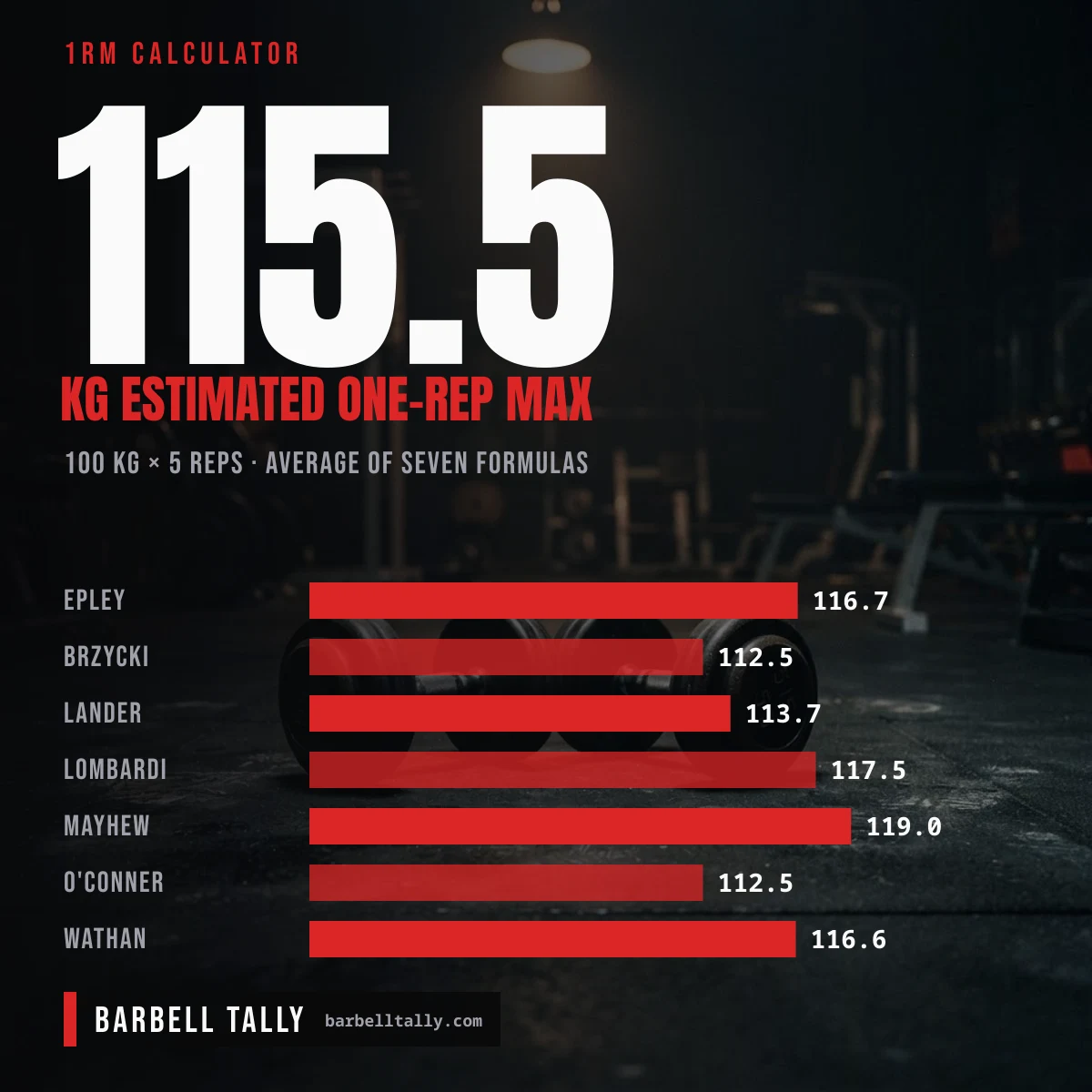
The seven formulas
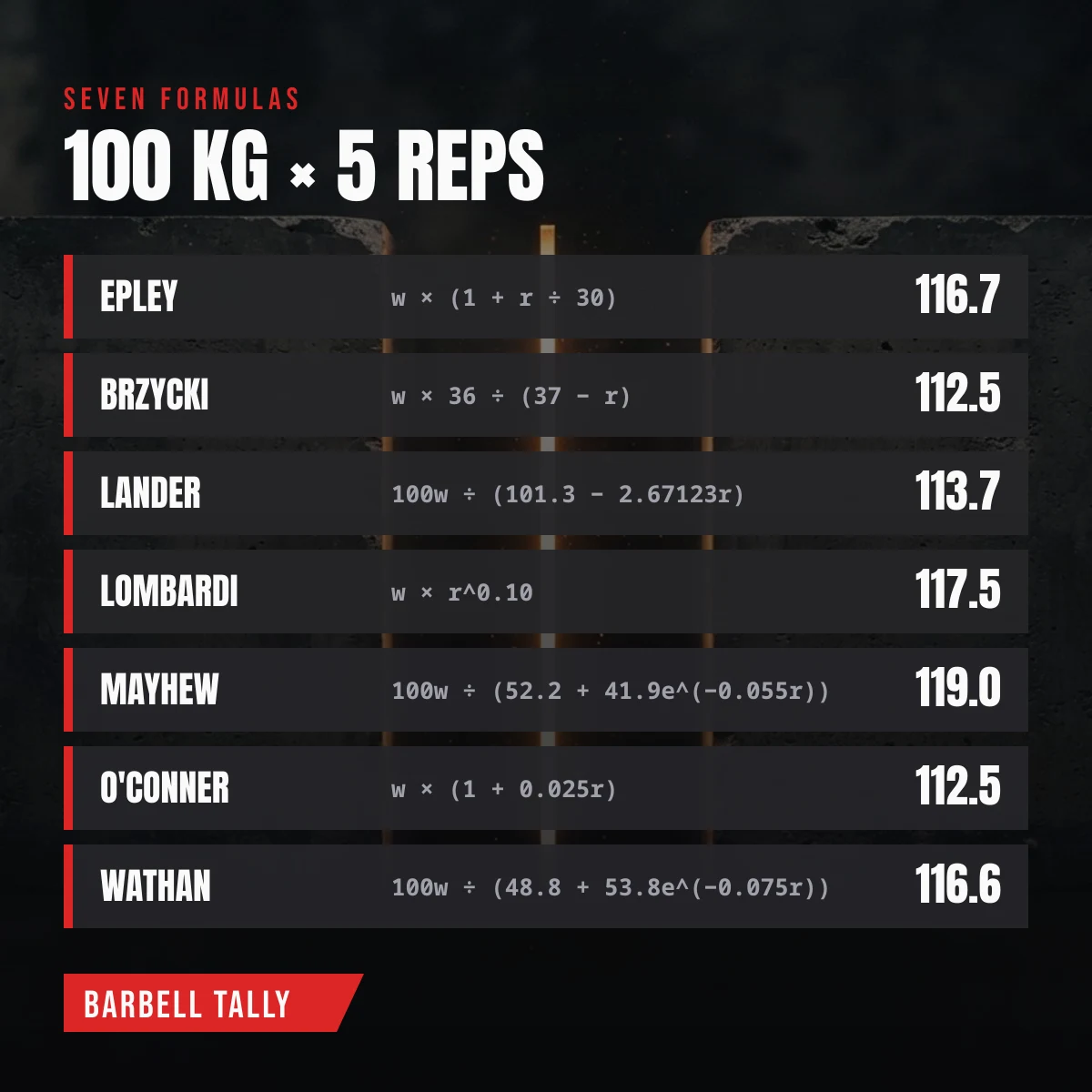
Each formula was published by researchers or coaches who fit a curve to rep data. They agree closely in the 3 to 8 rep range and spread apart as reps grow. Example below: 100 kg lifted for 5 reps.
| Formula | Equation | 100 kg × 5 |
|---|---|---|
| Epley | w × (1 + r ÷ 30) | 116.7 kg |
| Brzycki | w × 36 ÷ (37 − r) | 112.5 kg |
| Lander | 100w ÷ (101.3 − 2.67123r) | 113.7 kg |
| Lombardi | w × r0.10 | 117.5 kg |
| Mayhew | 100w ÷ (52.2 + 41.9e−0.055r) | 119.0 kg |
| O’Conner | w × (1 + 0.025r) | 112.5 kg |
| Wathan | 100w ÷ (48.8 + 53.8e−0.075r) | 116.6 kg |
| Average | mean of the seven | 115.5 kg |
Using percentages in training
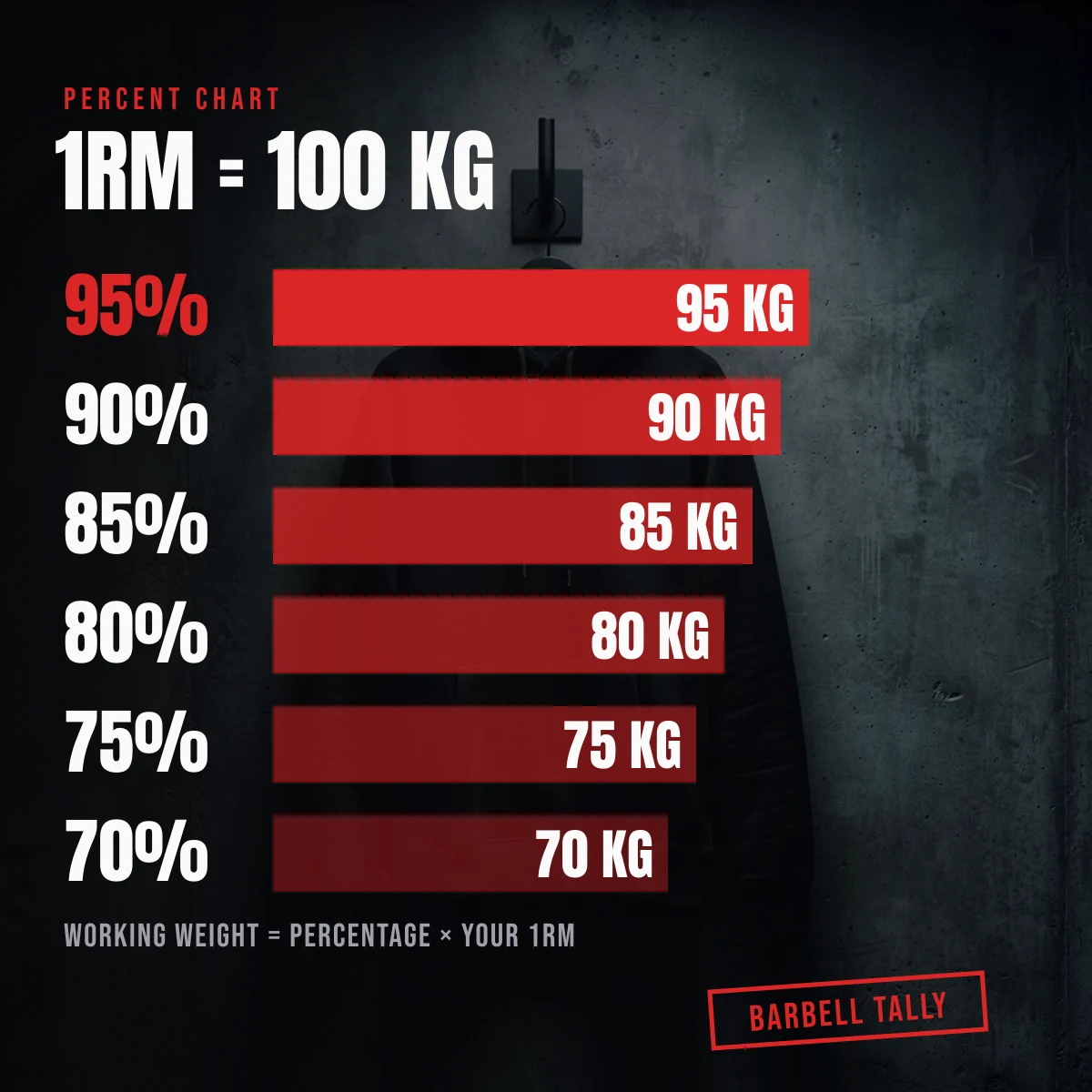
Once you have an estimate, the percent chart turns it into working weights. With a 100 kg max, the loads are simply the percentage of 100.
| % of 1RM | Weight (1RM 100 kg) | Typical use |
|---|---|---|
| 90–100% | 90–100 kg | Heavy singles and doubles, advanced lifters |
| 80–90% | 80–90 kg | Strength work in low rep ranges |
| 70–80% | 70–80 kg | Main sets for moderate reps |
| 60–70% | 60–70 kg | Technique and volume work |
| 50–60% | 50–60 kg | Warm-ups and light days |
Loading the barbell
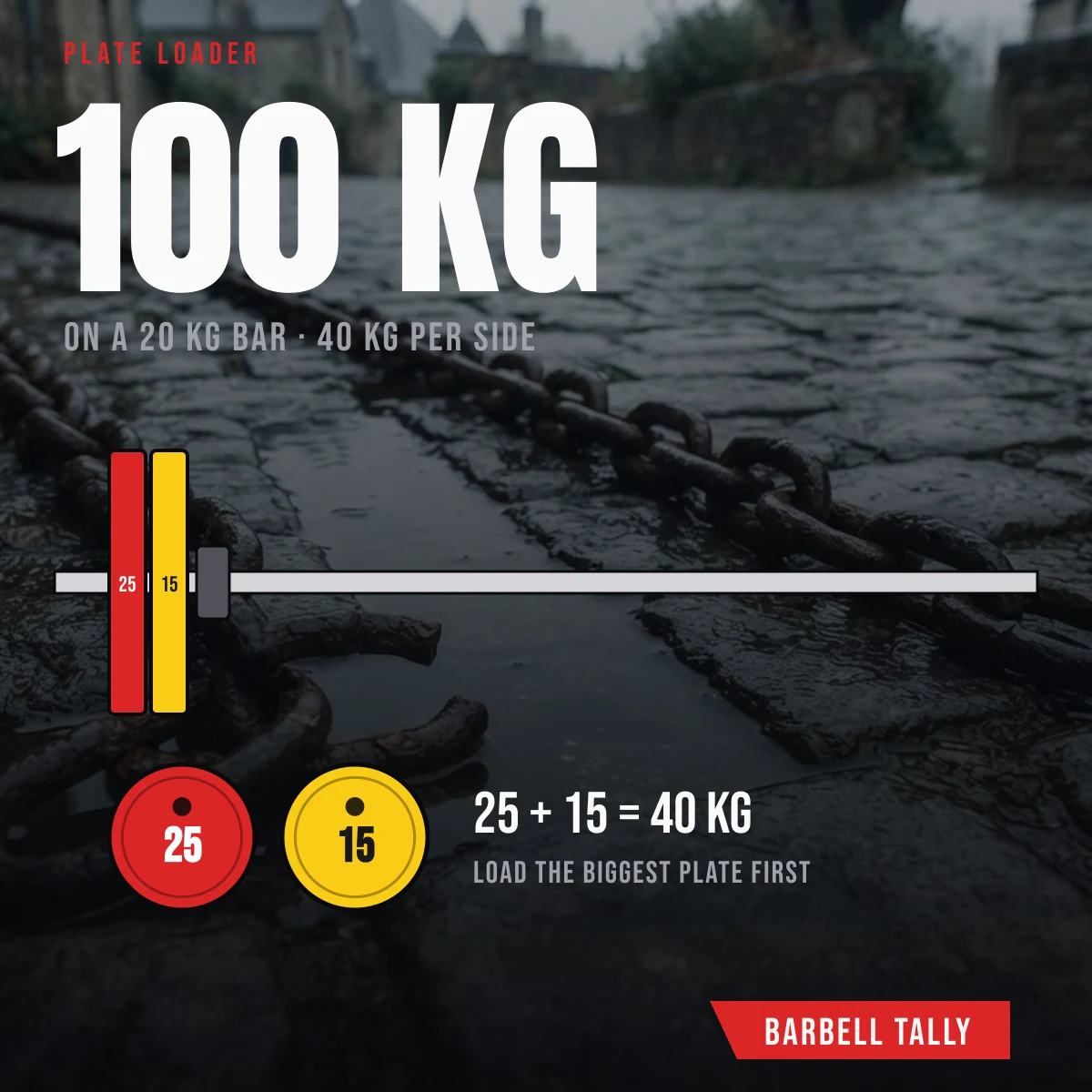
Subtract the bar, split what is left between two sides and load the biggest plates first. For 100 kg on a 20 kg bar, each side carries 40 kg: one 25 kg plate and one 15 kg plate. For 225 lb on a 45 lb bar, each side carries 90 lb: two 45 lb plates. Colored plates make this quick: in competition sets, 25 kg is red, 20 kg blue, 15 kg yellow, 10 kg green and 5 kg white.
Tips for a better estimate
- Use a set taken close to failure with clean form, not a set where the last reps fell apart.
- Prefer 3 to 8 reps. Very high-rep sets measure endurance as much as strength.
- Use the same lift and equipment each time so your numbers stay comparable.
- Treat the result as a range. Day-to-day readiness can move your real max by several percent.
Frequently asked questions
Is the 1RM calculator accurate?
It is an estimate. Formulas fit most people best between 2 and 10 reps and drift when the set is very long or when form breaks down. Different lifts, training history and fatigue move the real number up or down.
Which formula should I trust?
None is perfect. Epley and Brzycki are the most common. The calculator shows seven and averages them, so you can see the spread. If they are far apart, treat the middle of the range as your guess.
How many reps should I use for the estimate?
Use a hard but clean set of 3 to 8 reps. A single heavy rep is a test, not an estimate, and sets above about 10 reps give less reliable results.
Should I test my true one-rep max?
Only if your program calls for it and you have spotters or safety pins and a qualified coach nearby. Many lifters train for years using estimates and percentages only.
How does the plate loader work?
It subtracts the bar from your target, halves the rest for each side and adds the heaviest plates first. If the target cannot be built from your plates, it shows the closest load below it.
Does this give medical or nutrition advice?
No. It is a calculation tool. Talk to a qualified coach or health professional about your training, injuries and diet.
Was this set useful?
Log it as a good set, or flag what needs work.
Logged. Thanks for the feedback.